

Piri Reis Map: A Mysterious Journey Through Geography
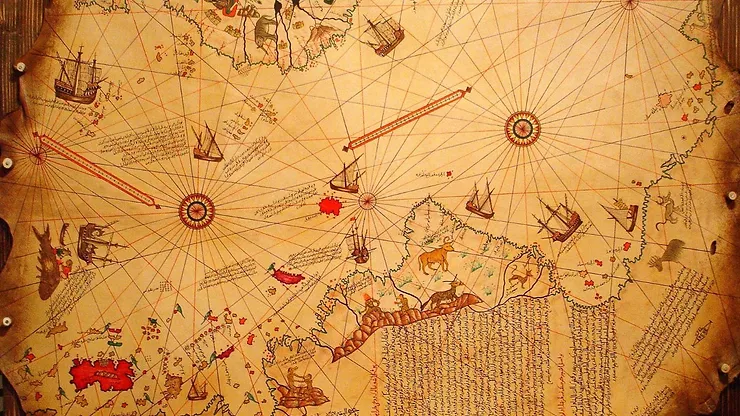
The name of Piri Reis, a legendary navigator and cartographer who lived during the Golden Age of the Ottoman Empire, was etched into eternity with the magnificent world map he drew in the early 16th century. Emerging as a masterpiece carrying the secrets of the American continent, the Piri Reis Map continues to harbor many mysteries to this day.
Piri Reis: A Navigator and Scholar
Ahmed Muhiddin Piri was a scholar who served as an admiral in the Ottoman Navy. He was renowned not only for his military genius but also for his profound interest and talent in geography and cartography. Among his works, the world map dated 1513 stands out as his most significant achievement.
Details and Mysteries of the Map
Beyond being a detailed world map, the Piri Reis Map is distinguished by its inclusion of parts of the American continent that were uncharted at the time. Stretching from the coasts of Brazil to Florida, this map demonstrates how advanced geographical knowledge was during that era. However, exactly how the map was drawn and where Piri Reis obtained his information remains a profound mystery.
The Astonishing Presence of Antarctica
One of the most striking details of the Piri Reis Map is the section at the bottom depicting a portion of Antarctica. This has sparked numerous debates, as Antarctica was an unknown continent during that period. Some scholars link the source of this information to lost ancient maps.
Theories and Speculations
Many theories exist regarding the Piri Reis Map. While some researchers suggest that Piri Reis compiled his map from various sources and a combination of ancient charts, others propose that the source of this information lies in a lost maritime tradition.
Conclusion
The Piri Reis Map brings with it meaningful questions regarding not only the history of geography but also the nature of exploration and the transfer of knowledge. The works of Ahmed Muhiddin Piri continue to help us understand the world as it was seen through the eyes of a navigator and a scholar.
Related Posts